 Influenza the Facts Influenza the Facts |
The Threat from Bird Flu
Mutations in avian flu could result in rapid spread of new epidemics, with large numbers of deaths.
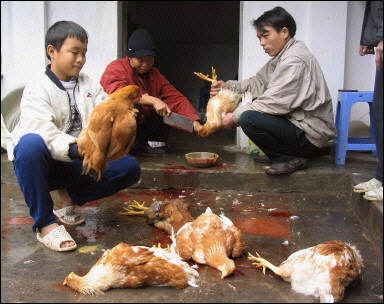
The World Health Organisation has warned repeatedly of the risks to global health from new mutant viruses - of which HIV, SARS virus and Bird Flu virus are just three of many examples we have seen.
Just one of these is Bird Flu - caused by virus H5N1. In mid April 2005 the Viet Nam Ministry of Health reported to WHO that 41 cases from 18 cities and provinces had been detected in since mid-December 2004. Of these cases, 16 had died and six remained under treatment.
Our world is very open to attack by Bird Flu viruses because we still have no antiviral drugs that are as effective as penicillin and other antibiotics against bacteria.

Vaccines are not available in large enough amounts to prevent a global pandemic of Bird Flu, if one begins. And even if they were, the fact is that 3 billion people live in areas with low health budgets and poorly developed health care systems. It would be impossible to vaccinate the whole world in time, because a Bird Flu pandemic could sweep around the entire globe in a few weeks or months.

Picture of flu virus
Many viruses are unstable and change all the time. Every time a new person or animal is infected, there is a chance of another mutation. Viruses also combine in unpredictable ways if a cell is infected with more than one virus type. The cell becomes confused about which virus it is making, and elements of both viruses get muddled up to create a new hybrid.
Bird Flu Information
The H5N1 threat to human health. Based on historical patterns, influenza pandemics can be expected to occur, on average, three to four times each century when new virus subtypes emerge and are readily transmitted from person to person. However, the occurrence of influenza pandemics is unpredictable. In the 20th century, the great influenza pandemic of 1918?1919, which caused an estimated 40 to 50 million deaths worldwide, was followed by pandemics in 1957?1958 and 1968?1969.
Avian influenza (Bird Flu) is an infectious disease of birds caused by type A strains of the influenza virus. Highly pathogenic avian influenza, such as that seen in H5N1 is characterized by sudden onset, severe illness, and rapid death, with a mortality that can approach 100%. H5N1 is of particular concern and it is widely held that H5N1 will be cause of the next human pandemic. H5N1 mutates rapidly and has a documented propensity to acquire genes from viruses infecting other animal species. Infected birds excrete the virus for at least 10 days, orally and in feces, thus facilitating further spread at live poultry markets and by migratory birds. Apart from being highly contagious, avian influenza viruses are readily transmitted from farm to farm by mechanical means, such as by contaminated equipment, vehicles, feed, cages, or clothing. Highly pathogenic viruses can survive for long periods in the environment, especially when temperatures are low.
The epidemic of highly pathogenic avian influenza caused by H5N1, which began in mid-December 2003 in the Republic of Korea and is now being seen in other Asian countries, is therefore of particular public health concern. H5N1 variants demonstrated a capacity to directly infect humans in 1997, and have done so again in Vietnam and Thailand. The spread of infection in birds increases the opportunities for direct infection of humans. If more humans become infected over time, the likelihood also increases that humans, if concurrently infected with human and avian influenza strains, could serve as the ?mixing vessel? for the emergence of a novel subtype with sufficient human genes to be easily transmitted from person to person. Such an event would mark the start of an influenza pandemic.
The current strategy is to minimize the global public health risks that could arise from large outbreaks of highly pathogenic H5N1 avian influenza in birds. An immediate priority is to halt further spread of epidemics in poultry populations. This strategy works to reduce opportunities for human exposure to the virus. It is also important to protect persons at high risk of exposure to infected poultry, with anti-influenza medications, can reduce the likelihood of co-infection of humans with avian and influenza strains, and thus reduce the risk that genes will be exchanged. To this end, our focus is to develop technologies and therapeutics that will achieve these important objectives.
Avian Influenza?a global emergency
Hundred million people could die from flu pandemic warns WHO. (AFP). November 29,2004.
Fears of Global Bird Flu Outbreak Increase. Fox News, December 01, 2004
Bird flu "far deadlier than SARS" Hong Kong (Reuters). November 29, 2004.
Expert warns next flu pandemic could destroy Earth's ecosystem. National post. December 7, 2004.
WHO Presses Governments, Fearing Bird Flu Pandemic. GENEVA (Reuters). Dec 8, 2004.
Flu Pandemic Inevitable, Plans Needed Urgently ?WHO. Reuters. November 26, 2004.
Warning as bird flu crossover danger escalates. The Observer. December 12, 2004.
HK in path of bird flu outbreak. CNN. December 8, 2004.
Three-level bird flu alert proposed for Hong Kong. (AFP). 7 December 2004.
Nation (Japan) must prepare for coming flu epidemic. (From The Yomiuri Shimbun, Dec. 7)
Doctors say bird flu could overwhelm U.S. hospitals. Metrowest Daily. November 29, 2004.
Expert says Canada not ready for pandemic. CBC Montreal.
UK prepares for flu pandemic. The Observer. December 12, 2004.
Avian Influenza?Facts
Influenza A viruses are found in many different animals, and usually specific to certain species, except for birds which are hosts to all subtypes of influenza A.
Influenza A viruses normally seen in one species sometimes can cross over and cause severe illness in another species.
Most cases of avian influenza infection in humans are thought to have resulted from contact with infected poultry or contaminated surfaces.
Outbreaks of highly pathogenic avian influenza A (H5N1) occurred among poultry in 8 countries in Asia (Cambodia, China, Indonesia, Japan, Lao, South Korea, Thailand and Vietnam ) during late 2003 and early 2004. At that time, more than 100 million birds either died from the disease or were culled.
The avian influenza A (H5N1) epizootic outbreak in Asia is not expected to diminish significantly in the short term. It is likely that H5N1 infection among birds has become endemic to the region and that human infections will continue to occur.
If these H5N1 viruses gain the ability for efficient and sustained transmission between humans, there is little preexisting natural immunity to H5N1 in the human population, and an influenza pandemic could result, with high rates of illness, social disruption, economic loss and death.
The World Health Organization estimates that an influenza pandemic involving H5N1 will most likely result in billions of people infected and 100 million deaths.
Avian H5N1 Bird flu may kill 150m people

Avian Flu Info
Bird Flu
Research & Facts
Cats catch Avian Flu
Controlling
Avian Flu
Emergency H5N1 Movies
Human implications
of influenza
Control
of Avian Flu
Avian Flu Medicines
Model of
Bird Flu Outbreak
SARS H5N1
BBC Article on Bird Flu
1918 Influenza Epidemic
Medicines
Amantadine H5N1 cure
Oseltamivir - Tamiflu
Rimantadine
- Flumadine
Vira 38
Zanamivir bird flu
Alternative Medication
World Virus Maps
May to October
Links
General Bird Flu links
International Organisations
Avian Flu References